R&D Management · Wiley Award
Waking the Sleeping Beauty
How Swarovski — a 125-year-old family business — reinvented itself through open innovation, and what legacy organisations can learn from its journey.
Innovation strategist · Researcher · Speaker · Educator
My work centres on one idea: innovation capability under uncertainty — how organisations anticipate, open, transform and scale when the future refuses to sit still.
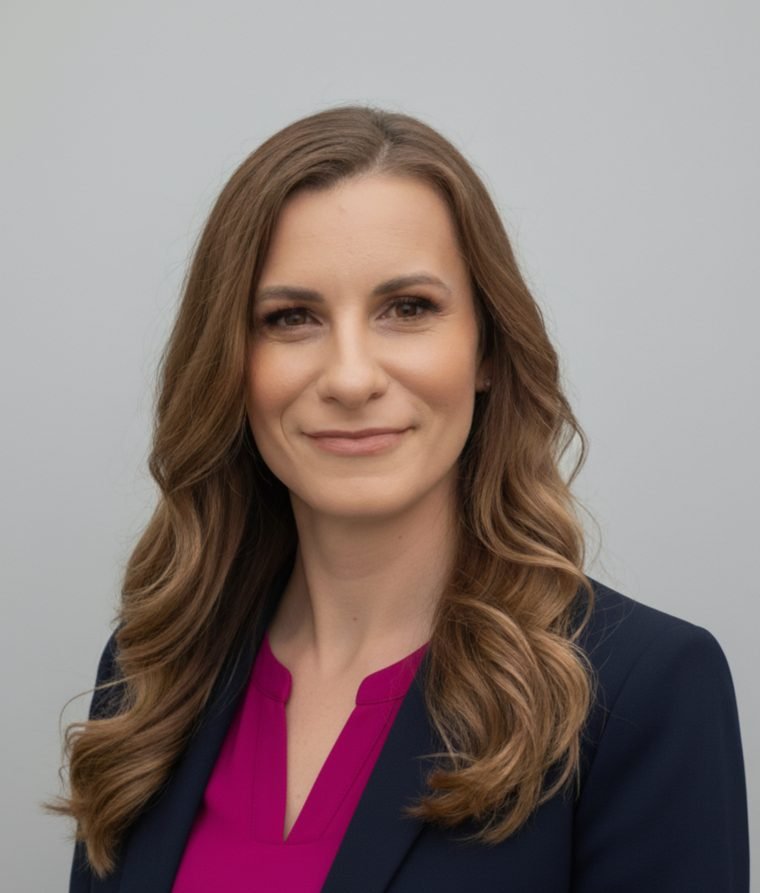
I'm Dr Justyna Dąbrowska — an internationally recognised innovation strategist bringing research-grade thinking on foresight, open innovation and digital & AI adoption into strategies, capabilities and tools that organisations actually use.
The through-line
Most organisations can run a project. Far fewer can build the capability to keep innovating when markets, technologies and rules keep shifting. That gap — between one-off innovation and a system that adapts — is the problem I've spent my career on.
See change before it's obvious — through foresight and scenario thinking.
Access and orchestrate knowledge, technology and partners beyond your walls.
Rewire how value is created with digital technologies and AI — through people, not just tools.
Turn experiments into durable organisational capability that lasts.
Foresight, open innovation, and digital & AI adoption aren't three separate services — they're the stages of one capability. Here's the research behind it →
The disciplines behind it
The arc runs on three research disciplines I've spent fifteen years in. Most organisations treat them as separate projects. They're stages of the same operating system for renewal.
Scenario planning and technology roadmapping turn uncertainty into strategy, so organisations shape the future instead of reacting to it.
Ideas, talent and technology flow across boundaries through ecosystems, partnerships and dedicated OI functions that make collaboration a capability, not an accident.
Emerging technologies change how value is created — but transformation succeeds through people, culture and capability, not tools alone.
Foresight tells you where to look, open innovation gives you the partners to get there, and digital & AI build the capability to deliver.
Ways to collaborate
Each conversation starts from the challenge you're facing, not a fixed package — and works back to the mix of foresight, open innovation and AI that fits. Depending on the opportunity, that might take shape as a talk, an executive-education session, a research collaboration or an advisory relationship.
The advantage of working with me is access to someone who is actively researching these phenomena internationally — publishing on them in leading journals, testing ideas with real organisations, and teaching them to executives and students. You get current thinking, not last decade's playbook.
Turn uncertainty into a strategy you can act on — spotting where value is moving before it's obvious.
Move from ad-hoc partnerships to a repeatable capability for innovating beyond your walls.
Lift your people's ability to innovate and adopt AI — through simulations, tools and applied learning that stick.
Ways in
A conversation might begin as a keynote that shifts how a room thinks, an executive-education session, an industry research collaboration, or an ongoing advisory relationship. Many start on stage — and each finds its own right home.
Speaking & keynotes
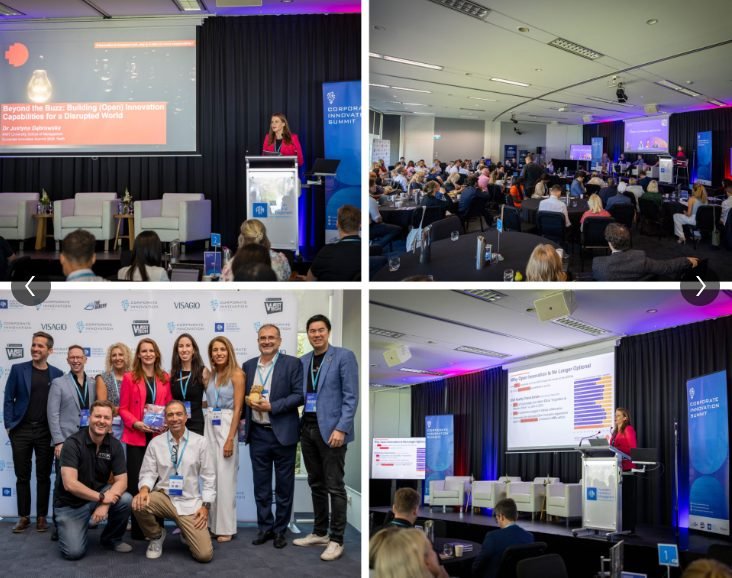
A sought-after keynote speaker on innovation strategy, AI in leadership and transformation culture — from corporate summits to national agencies and business schools.
The research agenda
How can organisations build innovation systems that are systematic enough to scale, yet open and adaptive enough to respond to uncertainty?
How can foresight help organisations recognise emerging opportunities before they become obvious?
Strategic foresight · scenario planning · technology roadmappingHow can organisations systematically access and orchestrate knowledge, technologies and partners beyond their boundaries?
Open innovation · ecosystems · dedicated OI functionsHow can organisations move experimentation into sustainable, repeatable organisational capability?
Innovation management · capability building · transitionRunning through all three: digital transformation and AI adoption — the technologies reshaping how organisations anticipate, open and scale. This thread anchors my EINST4INE work on industry digital transformation and my research on AI in leadership and education.
The evidence
Read the article — or watch the short video that unpacks it for practitioners. Research shouldn't stay behind a wall of jargon.
R&D Management · Wiley Award
How Swarovski — a 125-year-old family business — reinvented itself through open innovation, and what legacy organisations can learn from its journey.
California Management Review
Unpacking the forms and practices of the dedicated open innovation function — how leading firms actually organise, staff and run OI beyond the hype.
Research-Technology Management · 2026
A practical tool for navigating the exploration–exploitation divide — helping teams scale promising innovations without killing what made them work.
Innovation education
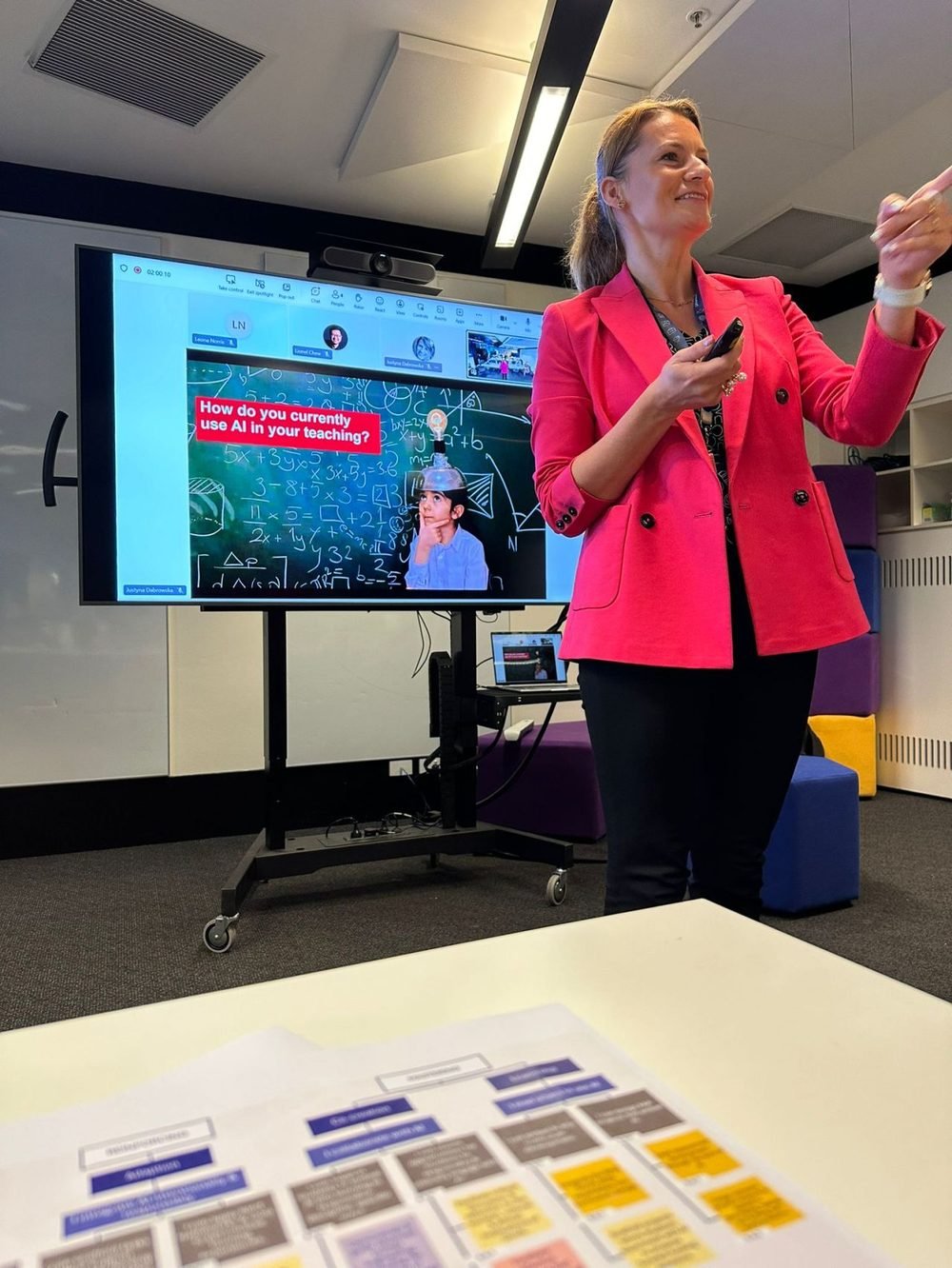
Innovation can't be learned from slides alone. I design evidence-based simulations, AI mentors and experiential tools that put learners inside innovation decisions — where they make the call, apply the framework and live with the consequences. This work earned RMIT's Dean's Merit Award for Innovative Learning & Teaching (2025).
Two custom AI-powered role-play simulations — the Open Innovation AI Mentor and the ExecMBA AI Mentor — that turn GenAI into an interactive learning partner rather than an answer machine.
Instead of handing over answers, the mentors place learners inside realistic innovation and strategy scenarios: make a decision, defend an assumption, apply a framework, then live with the consequences. The OI Mentor supports undergraduate learning around open innovation, collaboration and ecosystems; the ExecMBA Mentor puts experienced professionals inside complex technology and innovation strategy calls.
An open research lab making open innovation navigable: a live map of Australia's ecosystem, a directory of 80+ organisations, a research-based OI maturity assessment benchmarked against national data, and interactive learning tools. An RMIT-supported initiative I lead, designed and built end-to-end.
Open the OI Navigator 03 Workshop instrument · LiveMy most thesis-aligned tool: two linked canvases for building innovation capability under uncertainty. One maps where your organisation is heading; the other plans a single partnership in enough detail to survive contact with reality — seven gated stages, a coverage loop, and an A3 pack you keep. Free, no login, works offline.
Open the Compass & Canvas 04 In-class simulation · Facilitator packAn open-innovation simulation where no team can win alone. Teams design a vehicle under a budget and a clock, hand it to a production team who've never seen it, and discover they have to source, license and negotiate with suppliers, lead users and rivals to survive. Openness is never instructed — it becomes the obviously better move. A ready-to-run pack for bachelor through executive MBA.
Get the student packInnovation theory doesn't stick from slides. These are the browser-based games, simulations and workshop modules I build so teams can argue, decide and get things wrong in a safe room — used in bachelor and EMBA classrooms and in corporate workshops alike. All free, no login, open in any browser.
Designed and delivered at RMIT — integrating research, innovation practice, AI-enabled tools and gamified learning, and now complemented by Executive MBA teaching on technology and innovation strategy across courses at bachelor, master's and executive level.
Programmes & organisational work
The large-scale research programmes I've led or contributed to, and the organisations I've advised — where the thinking above meets real budgets, partners and decisions.
Co-Chief Investigator of the €4.06M European Training Network for Industry Digital Transformation — RMIT, Cambridge, Berkeley, LUT and 16 multinational firms.
Driving climate-positive futures — contributor and PhD co-supervisor on a €9.1M multinational program applying foresight to climate innovation.
Consortium manager and principal proposal author of the European Academic Network for Open Innovation — 52 organisations, 35 countries, and Europe's first OI education framework.
Translating research into strategy for partners including the City of Melbourne, Wyndham City Council, Australian Red Cross Lifeblood and the Australian Bureau of Meteorology — from innovation capability under heightened sensitivity to demystifying AI for operational teams.
Recognition
RMIT University · 2025 — for gamified, practice-connected innovation education.
RMIT University · 2025 — recognising consistently exceptional student outcomes.
R&D Management · 2019 & 2022 — for the Swarovski open innovation study and the digital transformation research agenda.
EU MSCA, Horizon 2020, Erasmus+, EIT and TEKES programs across Europe and Australia.
The story
I started in industry — supporting international and diplomatic accounts at General Motors Europe in Germany, and then managing sales across six markets in Central and Eastern Europe from Poland. That's where I first saw how large organisations struggle to change.
The question pulled me into research. In Finland, I completed a PhD in open innovation at LUT University while directing multi-country innovation programs worth over €23M — and building OI-Net, a network of 52 institutions across 35 countries.
Since 2019 I've been in Melbourne as Vice Chancellor's Research Fellow and Bachelor of Business Strategy and Innovation Major Manager at RMIT — writing, teaching, advising and building tools that help leaders adopt emerging technologies, including AI, through ecosystems and partnerships. I still believe the best strategy work happens where academia and business meet.
Questions I get asked
Short answers to the questions I'm asked most often — on stage, in workshops and by email.
Open innovation is the deliberate use of knowledge flows across an organisation's boundary — bringing external ideas, technologies and partners in, and letting unused internal ideas out. Henry Chesbrough coined the term in 2003 to challenge the assumption that serious R&D must happen in-house. In practice it means an organisation treats startups, universities, suppliers, customers and even competitors as legitimate sources of innovation, and builds the capability to work with them systematically rather than opportunistically.
It's a team with a formal mandate to manage innovation across the organisation's boundary — scouting, partnering, accelerating, sometimes investing. My research with Joona Keränen and Anne-Laure Mention in California Management Review found these functions vary enormously in scope and position, and that effective ones work across four domains at once: external scouting, ecosystem orchestration, building internal processes, and championing open innovation to colleagues who didn't ask for it. Most struggle not on the deal side but on that last one. Whether you need a dedicated function depends less on size than on whether partnerships keep happening by accident.
Capability is what remains after the project ends. It comes from four things working together: the ability to anticipate change through foresight, to open up and orchestrate external knowledge, to transform how value is created using digital technologies and AI, and to scale experiments into durable practice. Most organisations treat these as separate initiatives owned by different people. Treating them as one system — with explicit decisions, gates and a feedback loop — is what turns innovation from an event into a capability.
Forecasting tries to predict the single most likely future. Foresight accepts that the future is plural and builds strategies that hold up across several of them. It uses weak-signal scanning, scenario construction and technology roadmapping to surface the assumptions an organisation is quietly betting on. The output isn't a prediction — it's a set of better-tested options, and an organisation less likely to be surprised by something it could have seen.
No — and saying so out loud is overdue. With Henry Chesbrough, Paavo Ritala and fourteen co-authors I set out a critical research agenda in R&D Management under the title Digital transformation, for better or worse, precisely because the field had been written almost entirely as a success story. Digitalisation reshapes work, power and value capture at the same time: it creates winners and losers inside the same organisation, shifts autonomy and surveillance together, and can hollow out capability while appearing to add it. The useful question isn't whether to transform but for whom this is better, for whom it is worse, and who decides — asked at the individual, organisational and ecosystem level, not just the corporate one.
Both, and the distinction matters. The current research suggests AI is strongest as a divergent instrument — it widens search across languages, geographies and disciplines faster than any human team can, and surfaces internal knowledge an organisation has forgotten it owns. It is considerably weaker at converging: judging relevance, reading context, and persuading colleagues to back something. There's also a collective risk worth naming — Doshi and Hauser (2024) found AI-assisted work was individually more creative but measurably more similar across people. If the tool widening your search is widening everyone else's in the same direction, your advantage has to come from what the machine is worst at.
If a student can generate a competent answer in seconds, the assessment was never testing the thing that mattered. What AI cannot do for a learner is make a decision under uncertainty, defend it to a sceptical room, and live with the consequences — so that is what teaching has to be built around. In practice this means moving the centre of gravity from content delivery to judgement under constraint: simulations where resources are deliberately insufficient, role-play where information is asymmetric, and debriefs where students confront what they chose not to do.
It also means using AI as an interactive learning partner rather than an answer machine. My two custom mentors — the OI AI Mentor for undergraduates and the ExecMBA AI Mentor for executives — are built to put the learner inside a scenario and push back on their reasoning, not to hand over conclusions. Used that way, generative AI supports critical thinking and reflection instead of substituting for them.
The roles have multiplied well beyond the R&D lab. Organisations now staff dedicated open innovation functions, corporate venture capital arms, venture clienting programs, ecosystem orchestration and innovation scouting — a LinkedIn search returns well over a hundred thousand people with open innovation in their title or remit. Each of those roles is fundamentally relational: the work happens across organisational boundaries, with partners who have their own incentives.
That changes which skills matter. Technical depth still counts, but the binding constraints are now the ability to search beyond your own domain, to assess and absorb knowledge that wasn't invented here, to negotiate and structure partnerships, to orchestrate an ecosystem you don't control, and to make the internal case for something external. These are practised capabilities, not transferable facts — which is exactly why they resist being lectured at people and why experiential formats have become the serious option rather than the fun one.
Because innovation concepts that are explained get remembered for a week, and concepts that are experienced change how people act. In a well-designed simulation, nobody has to be told that not-invented-here syndrome is costly or that absorptive capacity is real — the room discovers it, usually by losing. The debrief then names what they just lived through, and the concept lands with evidence the participants produced themselves. This work earned RMIT's Dean's Merit Award for Innovative Learning & Teaching in 2025.
I've built ten free tools, all browser-based or print-and-run, with no login: The Vehicle Challenge, an in-class simulation where no team can win alone; the Uncertainty Compass & Partnership Canvas; Breaking the Boundaries, an open innovation quest with a certificate; JustInnovate — The Foresight Arc; The Evidence Room, twenty-three creativity activities graded by evidence strength; the OI Navigator ecosystem map and maturity assessment; two AI mentors; and three Mythbusters games on innovation, AI in higher education and the circular economy. They're free under Creative Commons for educational and non-commercial use — take them and adapt them.
My research asks one question: how can organisations build innovation systems that are systematic enough to scale, yet open and adaptive enough to respond to uncertainty? That breaks into three strands — how foresight helps organisations anticipate emerging opportunities, how they open up to access and orchestrate external knowledge, and how they organise and scale experimentation into lasting capability — with digital transformation and AI adoption running through all three.
On stage I speak on building innovation capability in a disrupted world, leading with AI, how AI is reshaping entrepreneurship and education, and demystifying innovation for teams who don't think of themselves as innovators. Engagements range from a conference keynote to an executive-education session, a hands-on workshop, a research collaboration or an advisory relationship — and many begin on stage and become something longer. I'm based in Melbourne and work internationally. Start a conversation and we'll find the right fit.
Let's talk
Speaking, podcasts, executive education, research collaborations, advisory or a capability-building partnership — tell me what you're working on and we'll find the right way in.
Depending on the opportunity, a conversation might become a keynote, an executive-education session, a research collaboration, an advisory role or a student project — let's find the right fit.
contact@justyna-dabrowska.com · Melbourne, Australia